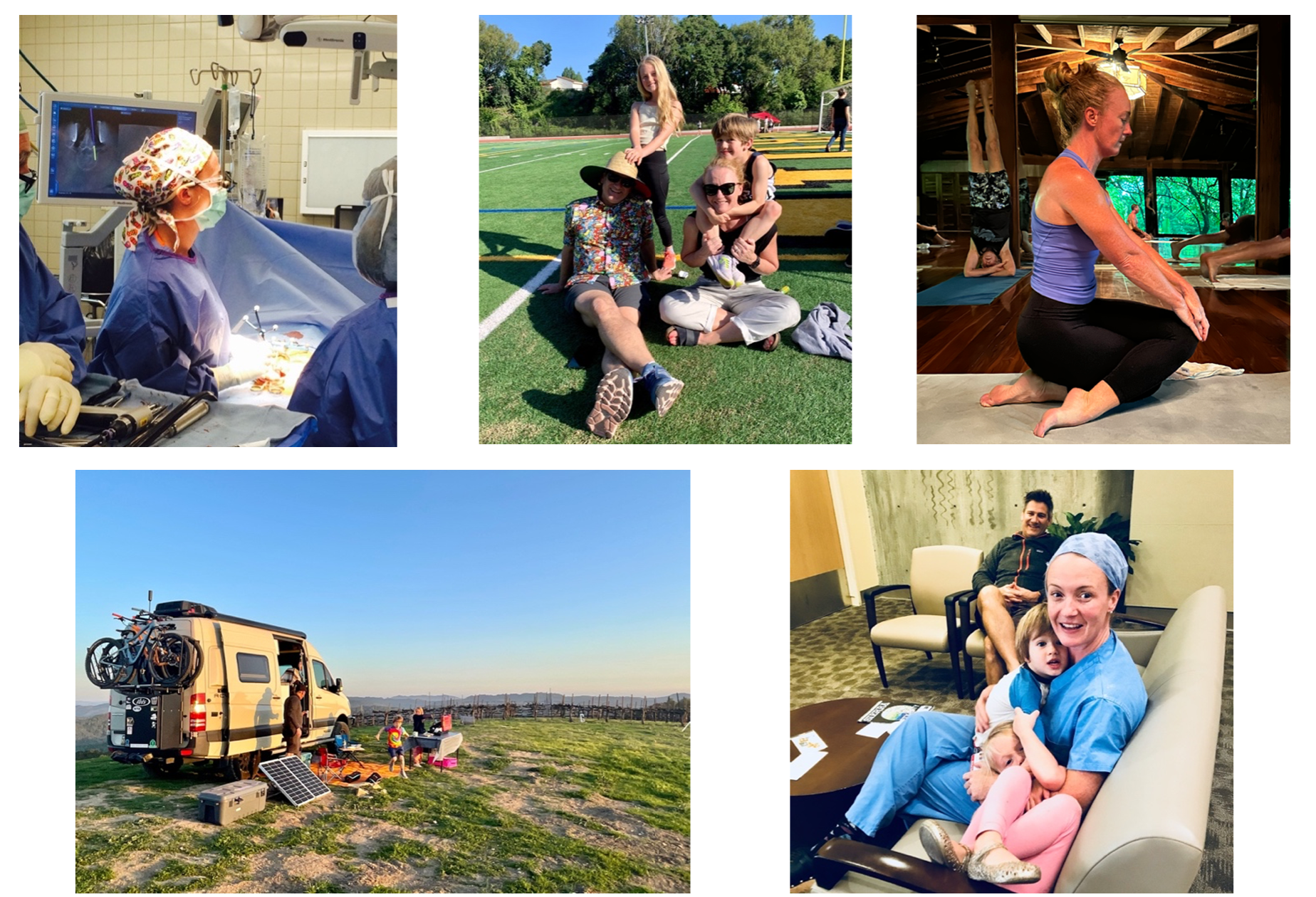
Welcome to the Faculty Corner Spotlight, a new initiative dedicated to fostering a culture of health, balance, and connection within our department. In the fast-paced world of academia and medicine, we often look to our peers for inspiration on how to navigate the demands of research, teaching, and clinical care.
Each quarter, we feature one of our colleagues to share their personal wellness journey. These stories highlight the “non-negotiable” habits that keep them grounded and the strategies they use to maintain boundaries and find joy in their work.
This Quarter’s Feature:
We are thrilled for our next feature of this series: Dr. Ciara Harraher
What does wellbeing or wellness mean to you?
I think wellness is when you’re able to manage all the spheres of your life – health, sleep, nutrition, fitness, family, your clinical practice, research or teaching. Well-being for me is making sure that I’m at least attending to and aware of area[s] I need to spend more focus on in the future.
If, [for example], I had a busy week at work, and I haven’t had enough time to go to the gym or spend as much time with my kids as I’d like… I want to at least notice that, so that I can attend to that. Maybe, the next week, if I’m not as busy, I [can] make the time to fill in those other spheres of life.
All those different pieces make the pie whole. [At] any given moment, you might not be succeeding at all of them at the same time. You need to pay attention to all of them and not let one piece of the pie get ignored for too long.
Can you give me an example of a kind of a self-care or wellness practice that you prioritize even when you’re busy with work?
Yoga has been a big part of my life since I was a teenager. My yoga practice has evolved, but, even if I only have time to do a short breath practice or meditation as part of my practice, yoga is definitely something that’s always part of my life.
That’s really cool. Do you go to a studio or do it on your own?
I started doing yoga when I was 18. I went to India and learned to practice Ashtanga Yoga. You can do it on your own, but it’s lovely to have a teacher. I have a few teachers around the world, [including] a friend of mine from India. We do [yoga] on Zoom, and I’ll attend workshops with her a few times a year. I do go to a hot yoga studio here in Santa Cruz…a couple of times a week if I can. Even though it’s not my style of yoga, it still allows me to do the aspects of yoga that are good for me.
Do you ever travel to any yoga retreats?
I usually try to do one retreat a year, even if it’s short. The one coming up is going to in Central California. I’ve been to one in Portugal…and in Costa Rica.
Do you feel that the focus and attention you give to yoga also influences aspects of your personal and professional life?
I’m grateful that, at [a] young age, yoga taught me a philosophy about how to live your life in a way that’s “loving-kindness” to yourself. There’s a principle in yoga called Ahimsa, which means non-violence…toward yourself. I think that’s been really helpful for me in my life and in my work. Yoga was the first place that I started to learn this principle of not being so hard on myself.
That’s such a beautiful sentiment…that permission to give yourself grace. Do you have any final thoughts to share?
Going back to what your first question was [about wellness]—is that [it’s] giving yourself the grace and kindness that, at points in your life, you’re not [always] going to have it all together. At points in your life, you’re going to feel like you’re failing as a mother, as a surgeon, a wife, a teacher, or whatever the thing may be.
My philosophy is that you’re never going to have it all perfectly balanced in every moment. Give yourself the grace that [it’s] okay. There are things that I need to not neglect, but [I know] not be hard on myself when I can’t fit them all in every day. That is part of the [“loving-]kindness” or nonviolence to yourself.